
Process Not Product

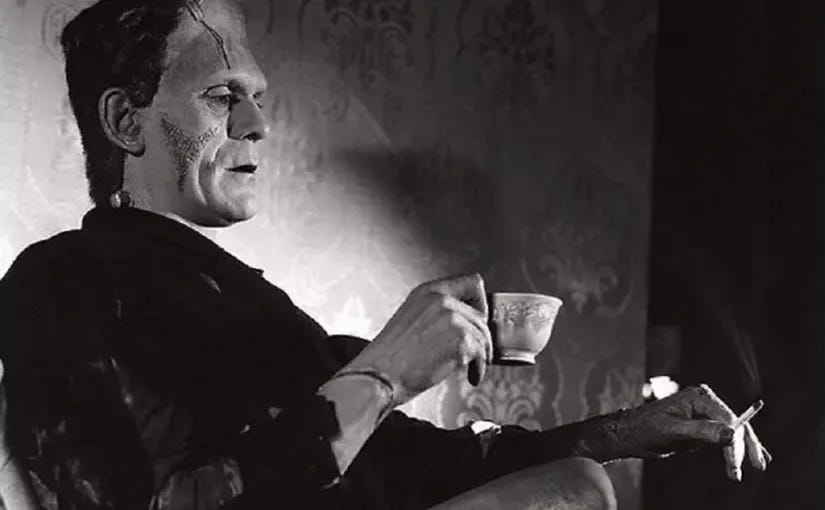
Perhaps one of the most confusing things about this current moment with the ‘rise’ of AI is that nothing is actually rising. I’m still hung up on the language. The image we’re given is Frankenstein’s monster on the table — 'I saw the dull yellow eye of the creature open; it breathed hard, and a convulsive motion agitated its limbs.’ But Shelley’s creature didn’t rise of his own volition. Victor stitched him together out of the dead, from materials he had collected and assembled. He was made out of us. Which is closer to what’s actually happening here than any image of a monster waking under its own power. The confusing thing, then, is that what’s under threat is not the act of creation but its monetisation.
A lot of the wails of despair I’m reading across the internet are from writers who are seeing their bottom line collapsing. People with ten, twelve books who can no longer get anyone to call them back. Or people with ambitions to write a novel who wonder why bother when someone with a subscription to Claude can generate one in an afternoon.
It’s not that AI made this collapse; it hastened it. Advances were already shrinking, journalism had already gone gig, the market for writing-as-product was nearly dead before LLMs got near it.
So what does teaching writing become, then? Well, funnily enough, I just wrote a book about exactly this. I’ve suffered a great deal over the years from writers who were making bank and patronising me with that old chestnut about those who can, do, and those who can’t, teach. One especially noxious individual told me she had no desire to teach because she was making so much money writing for the newspapers. Ten years later, she emailed me to see if I had any work going. Or there was the writer who told me I was ripping people off by giving them false dreams of literary success, and it wasn’t possible to teach it anyway. Well, excuse my smirk.
But I get it, the diminishing market is bitter and cruel, especially for those who have been schooled to think of writing as a possible career path. But advances have been dwindling for years, publishing houses consolidating, prizes losing their sheen. The industry has always been caught in the uncomfortable gap between creative production and commercial product, never quite reconciling the needs of the two.
This shift into AI is still playing itself out, and it’s going to have far-reaching consequences for the business of books. I doubt it will make them obsolete. In fact, we may find that as they become more costly to produce, there are fewer of them, and that they carry a premium of being ‘human-made.’ Who knows.
The rest of what follows is an edited version of the speech I gave at the launch of Between the Lines May, 12th at Birkbeck.
What I do know is that the writing workshop, the storytelling class, isn’t going anywhere, because as a method it teaches political, psychological and philosophical thinking better than direct instruction in those subjects.
Because writing a story requires understanding causation, agency, consequence — how one thing leads to another, what follows from what. Building a character is theory of mind in action, an act of imagining a consciousness that isn’t yours and following its logic with empathy and precision. Dialogue asks us to think about power: who speaks, who interrupts, whose voice allows them as inside or outside the room. Form is philosophical thinking, structure and pattern made visible. Revision teaches tolerance for uncertainty, the capacity to sit with not-knowing long enough to see the thing more clearly. And the workshop itself is a democratic practice - people in a room, reading each other’s work, listening to each other’s differences, paying collective attention.
This is Socratic education - learning as conversation, as encounter, as the kind of realisation that can only happen in a group, when someone else names what you couldn’t quite articulate and suddenly the temperature of the room changes. The close reading we do in creative writing classes is distinct from critical theory - not opposed to it, but it’s not the whole picture either. When we share stories, when we sit together and read each other’s work, we are, in and of itself, doing something political.
I love the word workshop. To me it conjures a timbered space full of tools - someone fixing a bike in one corner, someone painting, someone learning to sew or to sing. It stands for all the things we do better collectively, in person, with our hands and voices and attention. And crucially our bodies. The workshop is an embodied practice. You have to be in the room.
That’s not a small thing, so much of education has migrated to a screen, and we’ve largely accepted that as neutral, as just the way things are now. But there’s nothing neutral about it. The workshop insists on presence - on the particular quality of attention you can only bring when you’re physically together, when you can feel the hesitation before someone speaks, when the room actually changes. You can’t replicate that on Zoom.
Which is why I’d push back hard against the idea that what we do is a soft skill. In this moment - with the fracturing of shared reality, with AI-generated content flooding every channel, with people genuinely not knowing what to trust - the ability to sit with a story, to read it carefully, to respond to another person’s experience with honesty and precision: that is a hard skill. One of the hardest. The workshop is where you learn it, and the university is exactly where it should be taught.
Because the minute you start to interrogate where you come from - what’s local to you, what you’ve lived, what you’ve noticed - something interesting happens in the writing. It begins to come from its territory, its situation. My book is political by default rather than by design, because the personal is always already political, and the workshop is where that becomes visible.
And in the age of AI, I believe that work which comes from its territory - that situated, specific, embodied voice - is going to matter more, not less. Essentially, in the future we’re going to value, and need the process perhaps even more than the product, and maybe that’s not a bad thing.