
Reading the Room
On publication day

I was going to write something about my book, which is out in the world today. Something about what I was trying to do in the writing of it - to take the reader into the writing workshop and show them, through a series of invented scenes, what happens in that space.
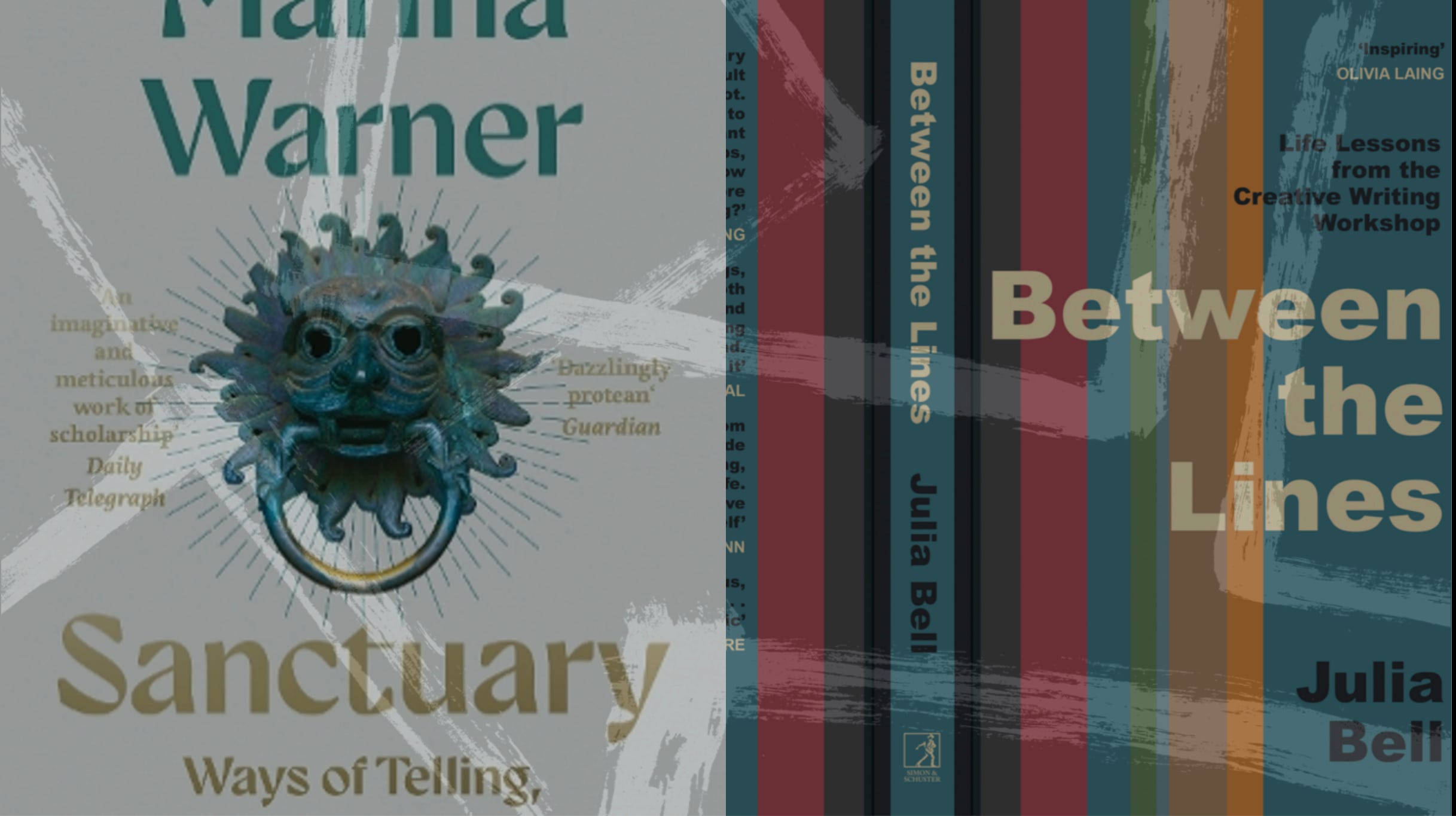
On Tuesday night, I enacted it. Marina Warner and I ran a talk and workshop on both our books at Birkbeck. Marina’s Sanctuary: Ways of Telling, Ways of Dwelling is a sweeping and ambitious piece of work, ranging across myth, history and literature, that thinks through the idea that places of sanctuary emerge from and are made of stories. Stories create our world; sharing them is how we transmit our experiences, our cultures, our desires. Between the Lines makes a similar case at a smaller scale - that the workshop is one of the places where this kind of sharing becomes formalised, and a site of profound emotional, philosophical and political learning.
After the talk, we ran a workshop. One exercise invited responses to the threshold: spaces where people cross from one place to another. Someone wrote about entering a wood-panelled room at a prestigious university, a doorway between ideas of class and privilege. Someone else wrote about being told she was going to die, and the dream she had on the threshold of life of a golden thread that tied her back. Another wrote about a smugglers’ cave in Cornwall, a liminal passage between different kinds of light.
What was exciting wasn’t the prompts but the affect. Bodies in the room, in conversation. The sovereign individual softened a bit at the edges through the simple act of sharing stories. There was a palpable sense of the people relaxing, to the point that another exercise had small groups making improvised theatre and making each other laugh.
I was going to share all this and my strong opinion as someone who has spent a lifetime in the classroom, that when we teach the arts of language, we are not just teaching people to write but to read, to speak, to listen, to think and to pay attention. Or rather not even teaching these things but remembering how to enact them with people outside our family and friend groups - strangers drawn together by a shared curiosity to interrogate the making of a story.
Then the political noise started creeping up on me as I was getting all jaunty. The weather of the day interfered. Pub date coincides with the local elections - a test of the new political landscape we find ourselves in.
There is a noticeable uptick in stories about Zack Polanski. Not serious interrogations of his policies or his ideas, or of the extraordinary membership surge that will express itself in the ballot box today. The Eye of Sauron lasers through his family, his job history, his colleagues, looking for something, anything - while at the other end of the spectrum is a character taking huge donations from a crypto bro and nobody seems to mind.
Meanwhile, Kath Viner, the Guardian’s editor-in-chief, said this week that the challenge posed by AI and political hostility to reporting meant ‘reality itself feels fake’ - while her own paper ran a story about Polanski padding his CV in place of any serious discussion of his policies. The diagnosis from the top is that reality has become unreliable. The reality, from where most of us are sitting, is that the people producing it are.
Marina argues that the stories we tell shape the world we live in. The corollary is that whoever controls the telling controls a great deal more than just the delivery. Right-wing coverage of Polanski has been reaching, in places, for antisemitic tropes whose lineage Marina has spent decades mapping - exactly the kind of long-running myths she traces. Some of these grievances even reach back to the most potent form of story - the sacred texts. To name this is not to say criticism of him is illegitimate; it is to say the form the criticism takes carries its own history, and history has baggage. The Guardian’s protectionism is a different expression of the same problem: a self-image of independence sitting alongside the routine reproduction of corporate, factional and class interest. It is not a lie that reality feels fake. It is a lie about who is making it feel that way.
What we do have, against all of this, however, is each other.
The diagnosis I keep coming back to is much older and much less fashionable, and it is this: people are alone. Hannah Arendt, in The Origins of Totalitarianism, describes loneliness as the soil in which authoritarian movements grow - not solitude, which is being alone with oneself and is generative, but loneliness, the specific modern condition of being among others and unable to reach them. Loneliness, she argued, makes people available to mass politics in a way that nothing else quite does, because mass politics offers what loneliness has destroyed: a feeling of belonging to something, of being part of a story larger than oneself, of mattering to a we.
Distracted by these thoughts, I watch some footage of a Reform rally on YouTube and notice that the people look, mostly, like they are having a good time. They are in a room with other people, laughing, and someone is buying the next round. There is a story being told that they are all part of. The story is bad, vicious, malevolent. But the form of the experience - the gathering, the belonging, the feeling of being heard – described so well in Year of the Rat by Harry Shukman - is something most people in this country have very little access to from one week to the next.
Farage’s message is, among other things, a project of belonging, organised around exclusion, fuelled by grievance, but still belonging. Anyone who wants to defeat it will have to compete on that ground, and the ground is not social media or the perfectly worded centrist op-ed. The ground is the room.
So here is the point: where, in your life, do you reliably gather with other people who are not your family, in pursuit of something you are doing together, on a regular schedule? For most people in Britain in 2026 the honest answer is nowhere. The trade union branch, the church hall, the working men’s club, the WI, the Saturday morning football, the evening class, the local theatre group, the community choir, the political party meeting that was actually a meeting and not a livestream - these have been hollowed out, defunded, or allowed to wither. Even the pubs and nightclubs are closing.
Into this void, people moan to the algorithms, which feed them more of the same. They are not meeting their neighbours; their opinions are being shaped by people thousands of miles away who have no skin in the game except to harvest their attention for clicks. This did not happen by accident. ‘Austerity’ took an axe to the public infrastructure of association. SureStart closed. Libraries went part-time and then closed. Adult education was gutted - between 2010 and 2020, the number of adults enrolled in publicly funded part-time courses fell by something like two-thirds. Youth services collapsed. Local journalism has contracted to almost nothing. Loneliness is what filled the gaps.
You can’t fix this with a more disciplined messaging strategy or a clever video. You can’t fix it from the top at all. You can only fix it the way it was originally constructed: by tens of thousands of people, in tens of thousands of places, deciding to make a room and asking other people in.
This, I think, is what Polanski’s Greens have understood. The membership numbers are striking not because they suggest a future Green majority - they don’t - but because thousands made the small gesture of joining something. They are, at the moment, the only national party offering people a way of doing a thing together rather than watching a thing happen, and the response is telling us something we should listen to.
What needs to happen now is the unglamorous, slow, repetitive work of rebuilding the commons - not as a campaign but as a habit. Reading groups. Writing groups. Walking groups. Allotments. Tenants’ associations. Mutual aid networks. Repair cafés. Choirs, especially the bad ones. Anti-racist organising in the places where Reform is winning. Faith communities, where they are not vehicles for exclusion. Local journalism cooperatives. Pub quizzes that meet every Tuesday, and notice when someone stops coming. None of it is sufficient. All of it is necessary - small sanctuaries against the maelstrom. The country is not saved by any one group; it is saved by the cumulative habit of people knowing each other.
I teach creative writing for a living, which gives me a particular and probably narrow view, but the workshop, when it works, is one of the small machines for making a collective we. As Rachel Cusk notes in her essay In Praise of the Creative Writing Course ‘the student who comes to the workshop lonely will leave it, one hopes, ready to be alone.’ People come into the room as strangers, and after ten weeks, they are no longer strangers. They have read each other’s sentences, disagreed, stayed in the room, and learned to pay attention to a person who is not them. The room from last night is one room. There are tens of thousands of others waiting to be made.
This resonates deeply with what I’ve watched happen in cycling over the past few decades.
We used to have a much richer club culture in Britain. Clubs were genuinely intergenerational spaces, where younger riders learned from older ones, where knowledge, stories, routes, and mechanical skills were passed along socially. Local bike shops were part of that ecosystem too. The humble sale of tubes, cables, pumps, and repairs helped sustain places that acted as community hubs as much as businesses.
But as cycling became more consumerist, a lot of that began to disappear. The easy sales were extracted by Amazon and online retail, while the social labour remained. Independent shops were left carrying the burden of community with far less financial stability to support it.
What’s left too often feels transactional. In some corners of cycling culture, belonging has been replaced by consumption and display. The bicycle becomes a lifestyle product rather than a shared social object.
That’s partly why getting involved with Pedallers Arms bike kitchen has felt so important to me. It reminded me that another culture still exists beneath all this. People helping each other repair bikes, sharing tools and knowledge, teaching without expecting profit from every interaction. It feels closer to an older civic culture, one built on participation rather than extraction.
I think you’re absolutely right that the answer lies in rebuilding the commons at a human scale: workshops, repair cafés, clubs, allotments, choirs, evening classes, reading groups, anywhere people gather regularly to do things together rather than simply consume side by side.
As a framebuilder, I’ve come to believe craft matters partly because it teaches this kind of social relationship. A workshop is never just about objects. It’s about attention, trust, apprenticeship, conversation, and mutual dependence. Those things don’t scale well, but they are exactly what make life feel meaningful.
The bicycle world once understood that instinctively. I think we need to rediscover it.
I was just sitting in my regular little indie coffee shop reading the para about Henry Shukman (& WHAT a book!) when the playlist started playing Cat Stevens, Wild World. I know it’s about something different, but it suddenly felt so resonant.
And yes: knitting group. This is Kent, remember - it’s not a Stoke Newington knitting group! - I’m learning a *LOT* about how sheltered (constrained, limited, conventional, anti-intellectual, ruled by the patriarchy) so many people’s lives have been! But I won’t miss a week unless I really have to.